
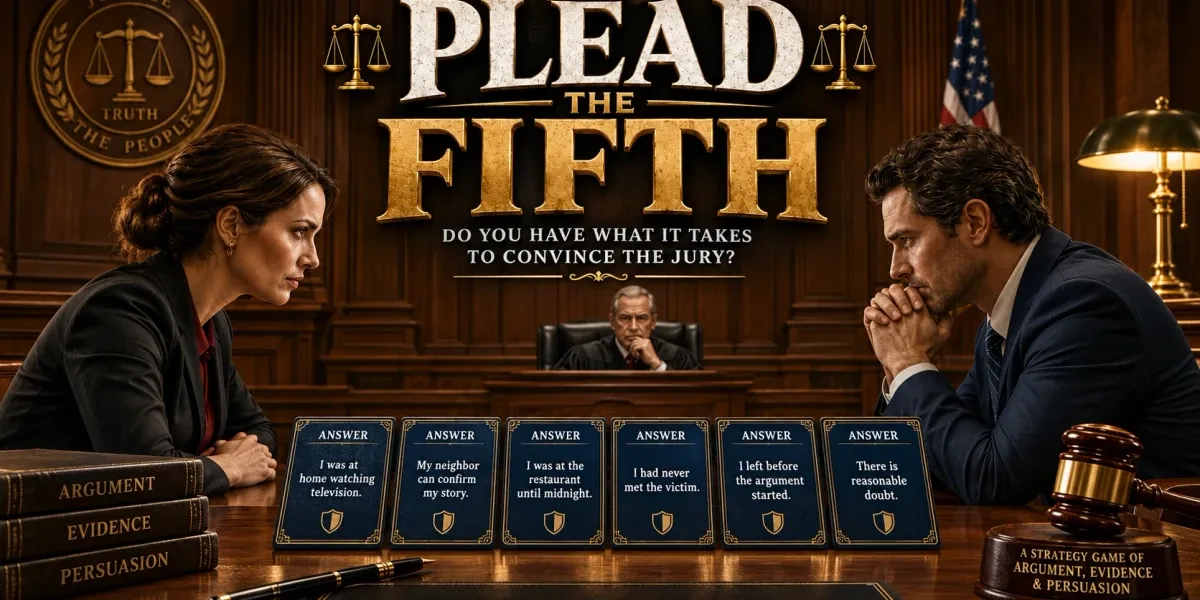
Plead the Fifth
Plead the Fifth is a two-player courtroom strategy game where one player prosecutes the case while the other fights to create reasonable doubt through card drafting, clever answers, and dramatic courtroom reactions. Influence a 12-die jury, build powerful arguments, and survive the final verdict — because the Prosecutor needs every juror convinced, while the Defendant only needs one.
John Garcia — Plead the Fifth is designed by John Garcia, the designer of the Table Golf Association.
What is Plead the Fifth?
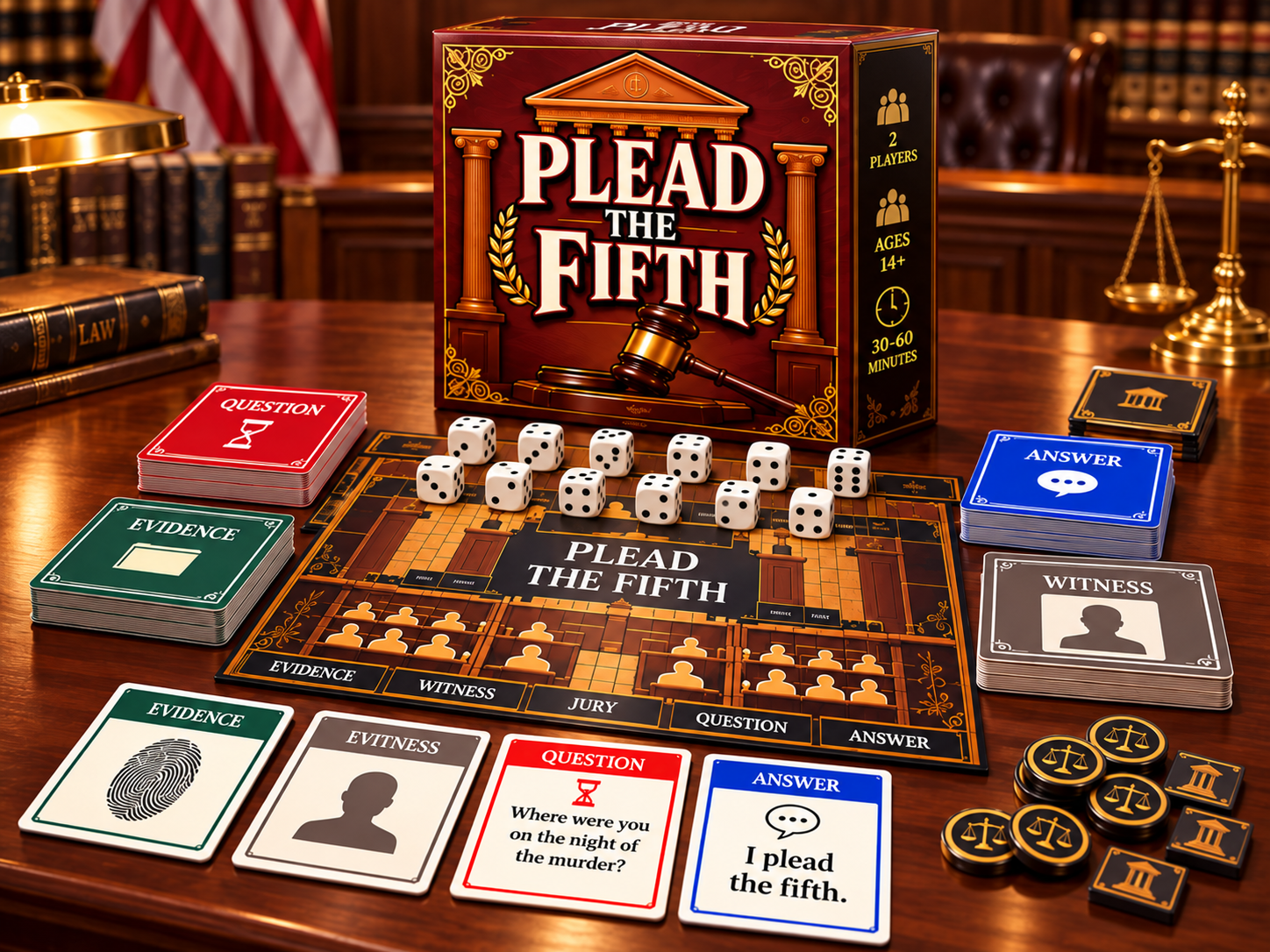
Plead the Fifth is a two-player courtroom strategy game where one player takes the role of the Prosecutor and the other becomes the Defendant. Through card drafting, question-and-answer exchanges, courtroom reactions, and jury manipulation, both players fight to control the outcome of the trial.
The Prosecutor asks questions and builds a case, trying to push all 12 Juror dice toward a Guilty verdict. The Defendant must answer every question — or use one of a limited number of Plead the Fifth cards — while creating reasonable doubt and pulling the jury back in their favor.
As the trial unfolds, players draft new cards, chain Follow-Ups, build powerful Sets, and earn special Courtroom cards like Objection!, Overruled!, Let Me Explain, and No Further Questions.
At any point, the Prosecutor can decide to rest the case and send the jury to deliberate. The remaining unconvinced Jurors are rolled behind a screen for one final dramatic verdict. If all 12 Jurors reach 6, the verdict is Guilty and the Prosecutor wins. If even one Juror remains unconvinced, the verdict is Not Guilty and the Defendant wins.
Prosecutor
The Prosecutor needs all 12.
Defendant
The Defendant only needs one.
How It Works
Why You'll Love It
Plead the Fifth turns every game into a tense courtroom showdown where no two trials play out the same way. The asymmetric roles make each side feel completely different.
As the Prosecutor, you're building pressure, exposing weak answers, and trying to convince every last Juror. As the Defendant, you're managing your hand, creating reasonable doubt, and deciding when it's worth the risk to Plead the Fifth.
You'll draft cards, build clever combinations, trigger Follow-Ups, and earn dramatic Courtroom cards that can completely change the momentum of a case. An Objection!, Overruled!, or perfectly timed No Further Questions can turn a routine exchange into a memorable moment.
And throughout the entire trial, the 12 Juror dice show exactly what's at stake. You can literally watch the Jury shift as each argument lands. Then comes the moment everything has been building toward: "The Prosecution Rests." The remaining Jurors are rolled behind the screen, the verdict is revealed, and one final die may decide the entire case.
Strategic. Dramatic. Unpredictable. And always down to the verdict.